

CARE Seminar by Dr. Nguyen Truong An: Contrasting Agricultural and Urban Greenhouse Gas Signatures - The River-to-Coast Trajectory of the Mekong Delta and Saigon River
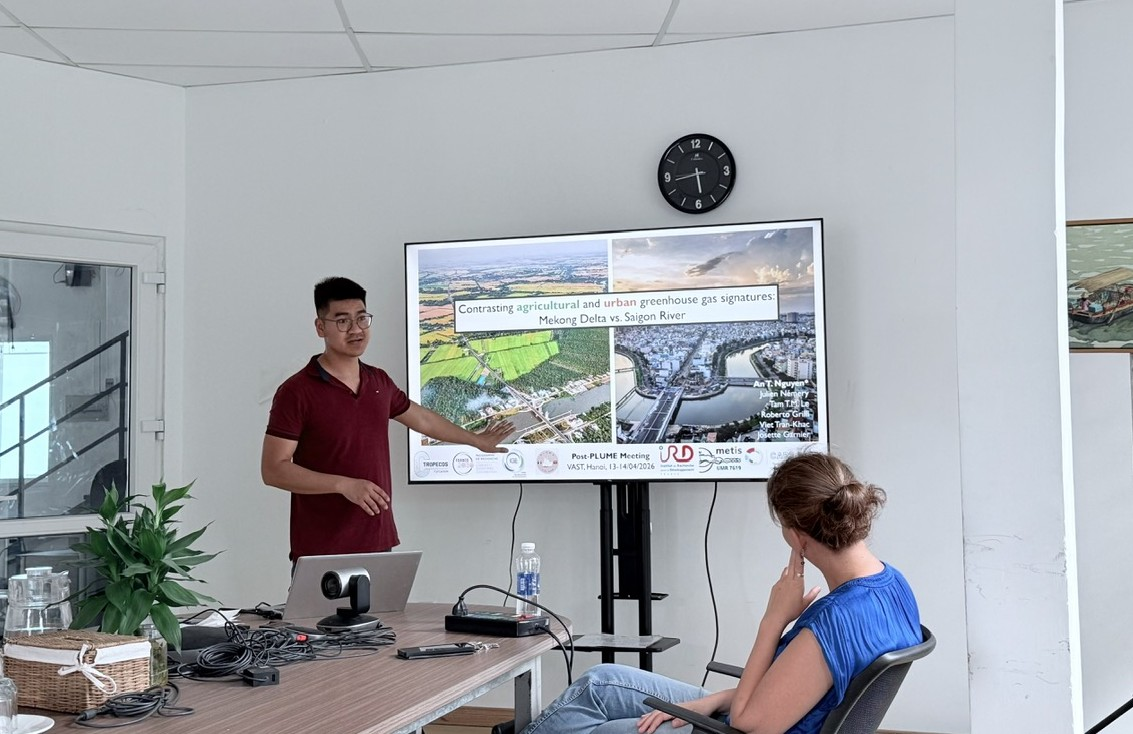
On Thursday, April 16, 2026, CARE organized a research seminar presented by Dr. Nguyen Truong An (IGE/IRD).
The seminar, entitled “Contrasting agricultural and urban greenhouse gas signatures: The river-to-coast trajectory of the Mekong Delta and Saigon River” , focused on recent findings from the 2024 wet-season PLUME campaign in southern Vietnam.
Tropical river-dominated margins are globally significant sources of greenhouse gases (GHGs) to the atmosphere. However, the distinct metabolic trajectories of heavily urbanized versus diffuse agricultural catchments and their ultimate fate on the coastal shelf remain poorly resolved. Here, high-resolution, source-to-sea observations were presented to compare two contrasting systems discharging into a shared coastal ocean: the megacity-dominated Saigon River and the agricultural Mekong Delta.
By coupling approximately 96,000 continuous flow-through observations (pCO₂, CH₄, salinity) with a 101-station discrete grab network (organic carbon, nutrients, Chl-a), the study reveals clear biogeochemical contrasts. The Saigon River acts as an extreme “Urban Reactor”, driven by severe respiration of untreated organic loads, resulting in pronounced hypercapnia and spatial decoupling of greenhouse gases. In contrast, the Mekong Delta operates as a moderate “Diffuse Engine”, displaying steady, agriculture-driven baseline emissions with significantly lower respiration pressure.
Despite their vastly different inland signatures, both systems converge into a highly efficient carbon sink on the coastal shelf. Within the mid-salinity plume (15–25 PSU), the system shifts from net respiration to net primary production. Over 95% of daytime observations in this coastal zone act as a CO₂ sink, overlapping with the inner-plume Chlorophyll-a maximum.
These results highlight the role of the tropical coastal ocean as an active biological buffer, where riverine nutrients stimulate phytoplankton growth that mitigates estuarine emissions. Ongoing work integrates these observations into a coupled mechanistic model to simulate future carbon dynamics under changing anthropogenic pressures.
The seminar provided valuable insights into river–coast interactions and contributed to ongoing discussions on climate-relevant biogeochemical processes in tropical environments. CARE would like to thank Dr. Nguyen Truong An for his insightful presentation.
566