
INTO THE STEAM: KICKING OFF FIELDWORK AT THE BUNG THI HOT SPRING
Originally posted: 14/11/2026
Researchers from the Faculty of Geology and Petroleum Engineering (GEOPET) and CARE – Ho Chi Minh City University of Technology (HCMUT) have carried out the first field investigation of a new research project entitled “Hydrogeological structure of the hot mineral water outcrop area in Ham Thuan Nam (Binh Thuan) and its exploitation potential”.
The 24-month project is led by Dr. Trần Anh Tú, Dr. Trương Quốc Thanh and Dr. Lê Thị Minh Tâm, with the support of graduate and undergraduate researchers.
Why this site matters
At Bung Thi, hot mineral water seeps to the surface through the sandy ground, producing steaming streams, white mineral crusts and rust-stained wellheads. The water is hot enough for local visitors to boil eggs directly in the outflow, as the team also did. Behind these features lies a geothermal system that remains surprisingly little known: where the water comes from, which faults and fractures carry it upward, and how much of it can be used sustainably.
What the team is doing
Mapping the hydrogeological setting and the water-bearing fracture zones, and running geophysical surveys (electrical resistivity imaging along multiple profiles) to image the subsurface structure;
Measuring water temperature on site and collecting samples for hydrochemical and isotope analyses to trace the origin of the water;
Assessing the geothermal and hot mineral water potential for sustainable uses such as balneotherapy, eco-tourism and local development.
The first field campaign provided fresh samples, temperature readings and a clear picture of the outcrop zone. The team sincerely thanks the local forest rangers who guided them through the site and looks forward to sharing results as the project moves ahead.
This research is funded by Vietnam National University Ho Chi Minh City (VNU-HCM) under grant number B2026-20-13.
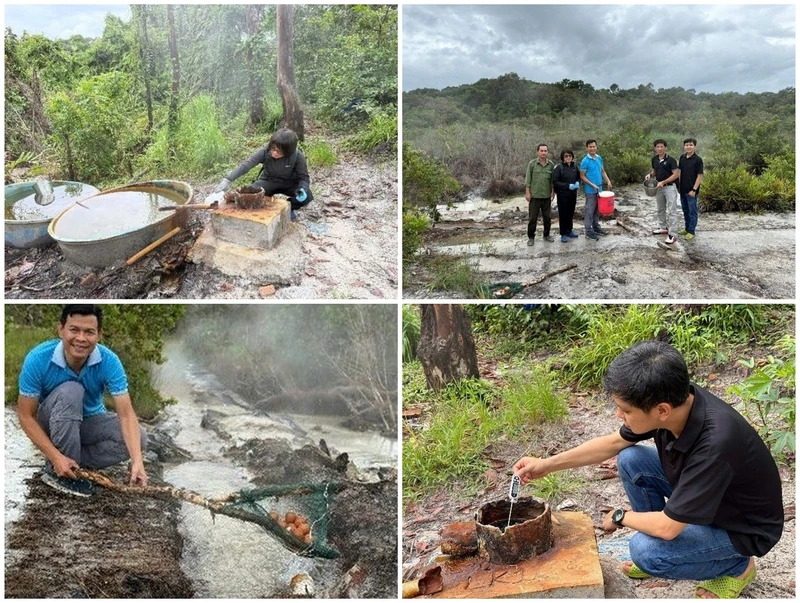
Figure 1. Fieldwork at the Bung Thi hot spring: collecting hot mineral water samples (top left), the research team with a local forest ranger (top right), boiling eggs in the hot spring outflow (bottom left) and measuring water temperature on site (bottom right).