
CARE SEMINAR IN JULY 2026: SECOND SESSION OF THE INTERNSHIP STUDENTS TALK SERIES
Originally posted: 24/07/2026
On July 24, 2026, CARE organized the second session of the Internship Students Talk Series at CARE - HCMUT. Two young researchers hosted at CARE presented their ongoing work on salinity, water quality, and estuarine dynamics in southern Vietnam.
Adrien Arnoux (4th-year Engineering student at Polytech Montpellier, University of Montpellier, France), supervised by Prof. Đào Thanh Sơn, presented “Influences of Salinity Increase and Trace Metals on Phytoplankton under Laboratory Conditions”. Coastal and deltaic regions of Vietnam are increasingly exposed to two combined pressures intensified by climate change: seawater intrusion and heavy metal contamination. Through three sequential 15-day experiments, he assessed the individual and combined effects of increasing salinity (1, 2 and 4 ‰) and three trace metals (Zn, Cu, Pb) on the freshwater colonial microalga Pediastrum isolated from the Saigon River. Metals alone caused only a transient inhibition of growth, whereas salinity alone strongly and persistently reduced growth, photosynthetic pigment content, and protein synthesis. At low salinity, sodium chloride partially buffered metal toxicity, but at higher salinity osmotic stress became the dominant factor. These results suggest that, for tropical freshwater phytoplankton, salinity may represent a greater ecological threat than trace metal pollution alone, with markedly non-additive combined-stress interactions.
Dương Phước Lợi (Master's graduate in Civil Engineering, specialization in Water Resources Engineering at HCMUT), supervised by Dr. Trần Hải Yến, presented “Numerical Simulation of Saltwater Intrusion in the Hau–Bassac River Estuary Using the CROCO Model”. Using the three-dimensional open-source CROCO model with AGRIF grid nesting, he investigated the spatial and temporal variability of salinity in the Hau–Bassac estuary, with particular attention to the Định An and Trần Đề estuaries. The calibrated model reproduced the main semidiurnal tidal pattern at Cần Thơ and Đại Ngãi, as well as the characteristic salt-wedge structures, with stronger inland intrusion during the low-discharge dry season. Sensitivity experiments indicate that river discharge is the dominant factor controlling the inland extent of saltwater intrusion, while increased bottom roughness shortens the salt wedge. These preliminary results demonstrate the potential of CROCO for estuarine salinity studies and highlight the need for further calibration and improved bathymetry.
CARE would like to thank our speakers and their supervisors for the quality of this session, as well as all participants who joined on site and online.
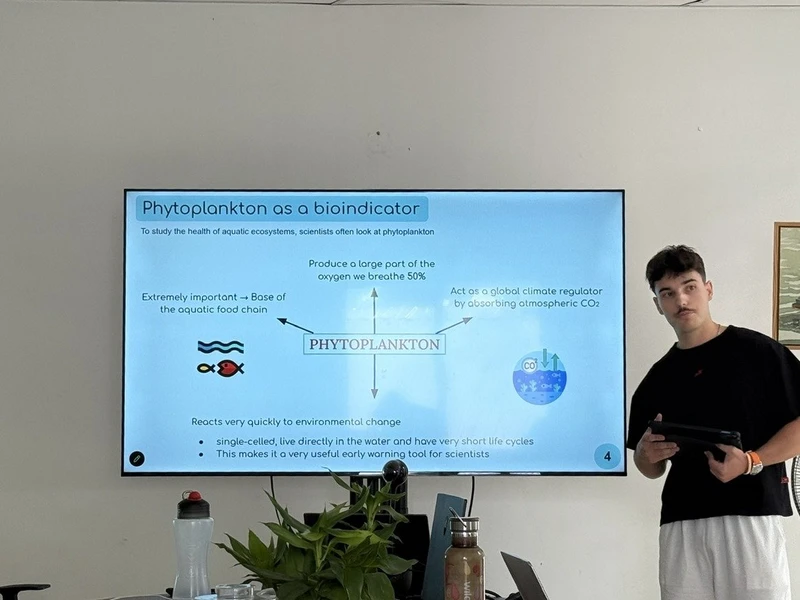
Adrien Arnoux presenting his research on the effects of salinity and trace metals on phytoplankton.
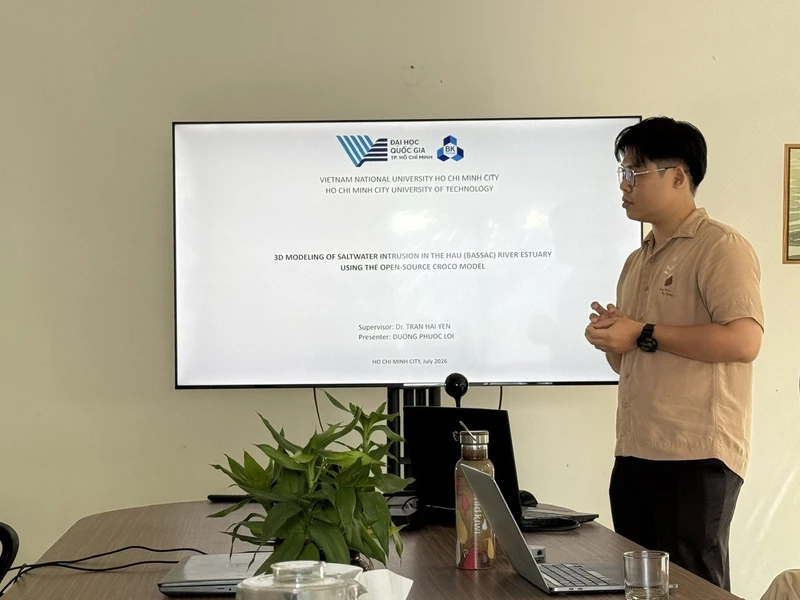
Dương Phước Lợi presenting his numerical modeling of saltwater intrusion in the Hau–Bassac River estuary.