…

…
Marine Pollution Bulletin 174 (2022) 113302
Authors: Thuy-Chung Kieu-Le a,b , Quoc-Viet Tran b,c,d , Tran-Nguyen-Sang Truong b,c,d , Emilie Strady d,e,*
a Faculty of Geology and Petroleum Engineering, Ho Chi Minh City University of Technology (HCMUT), Viet Nam
b Vietnam National University Ho Chi Minh City (VNU-HCM), Viet Nam
c Faculty of Environment and Natural Resources, Ho Chi Minh City University of Technology (HCMUT), Viet Nam
d Asian Center for Water Research (CARE), Ho Chi Minh City University of Technology (HCMUT), Viet Nam
e Aix-Marseille Univ., Mediterranean Institute of Oceanography (M I O), Marseille, Universite de Toulon, CNRS/IRD, France
Accepted 24 December 2021
Available online 4 January 2022
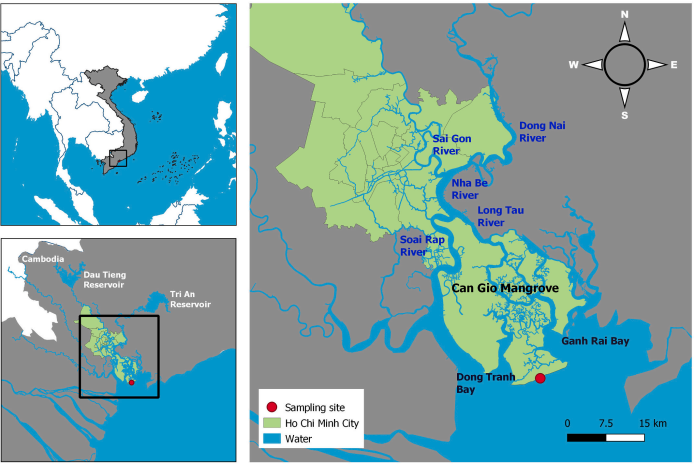
Abstract. Anthropogenic fibres are an emerging pollutant worldwide. The Can Gio mangrove area is located downstream of the Saigon River, and is characterised by high level of anthropogenic fibres originating from domestic and industrial textile and apparel manufacturing. In this area, biota is thus subjected to a high potential risk of anthropogenic fibre contamination. This study aims to characterise the accumulation of anthropogenic fibres in different tissues, i.e. gills, digestive systems, and remaining tissues, of white clams (Meretrix lyrata) cultivated in the Can Gio beach sand, during a seven-month sampling period.
The results showed an average concentration of 3.6 ± 2.1 fibres individual− 1 or 2.7 ± 2.4 fibres g− 1 ww. Higher fibre accumulation was observed in remaining tissues than in gills and digestive systems, and no temporal variation was observed in all clam tissues. The intake of fibres by humans consuming clams was estimated to be 324 fibres inhabitant− 1 yr− 1