
Understanding Impacts of Groundwater Extraction on Flow Dynamics in Multi-aquifers of Ho Chi Minh City Area, Vietnam
We are pleased to introduce the research article titled \"Understanding the Impact of Groundwater Extraction on Flow Dynamics in Multilayered Aquifers in Ho Chi Minh City, Vietnam\" by authors Quang-Khai Ha and Sucharit Koontanakulvong, published in the Journal of Water Management Modeling (2024).
This study is a key contribution to the project “Enhancing Research Capacity and International Collaboration of the Centre of Asian Research on water” by CARE, and was funded by Vietnam National University Ho Chi Minh City (VNU-HCM) under grant number DA2024-20-01.
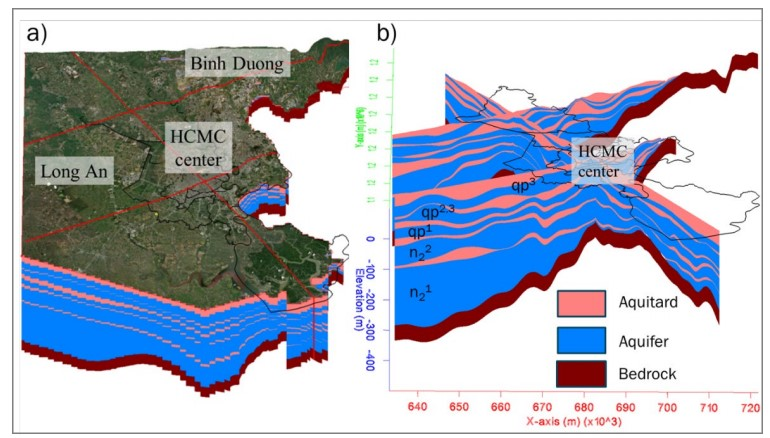
Understanding the dynamic characteristics of the groundwater flow budget is crucial for effective water management. This study investigates the groundwater budget in the Ho Chi Minh City (HCMC) area by the application of groundwater flow modeling. A 3D model was built to simulate groundwater flow in aquifer systems in Ho Chi Minh City, using extensive hydrogeological data from 400 borehole logs, along with climate, hydrological, and groundwater extraction data. The model was calibrated in both steady-state and transient conditions, with monthly data from 1995–2007, and then validated using five years of monthly groundwater level monitoring data from 2008–2012. In general, the calibrated and validated models show a good match between calculated and observed groundwater levels,with R2 values > 0.8. The model results illustrate that recharge rates in HCMC vary according to local geological conditions and fluctuate seasonally due to changes in climate factors such as rainfall and evaporation. The annual recharge rate did not significantly change during 1995–2012. A groundwater depression cone was observed in the city center, with a maximum groundwater level approximately 50 meters below mean sea level (bmsl). Groundwater extraction increased sixfold from 1995–2012, which is the main cause of groundwater level decline. This study also found that the river system plays an important role in maintaining the groundwater balance in the area. As a result, increased groundwater exploitation has induced a fourfold rise in river leakage, while groundwater discharge to the river decreased by 35% during the same period. These changes potentially contribute to increased risks to groundwater quality, a reduction in base flow within the river system, and greater vulnerability of the natural ecosystem.
For detailed insights, access the full article here: https://doi.org/10.14796/JWMM.S533