

Responses of a tropical micro-crustacean, Daphnia lumholtzi, upon exposures to dissolved toxins and living cells of cyanobacteria
SEMINAR: Responses of a tropical micro-crustacean, Daphnia lumholtzi, upon exposures to dissolved toxins and living cells of cyanobacteria
10 AM Tuesday, 17th November, 2020 - CARE meeting room (B7, 1st floor)
Thi-My-Chi Voa, Ba-Trung Buib,c, Claudia Wiegandd, Khuong V. Dinhe,f, Thanh-Son Daog*
aInstitute of Research and Development, Duy Tan University, Da Nang, Vietnam.
bInstitute for Environment and Resources, VNU-HCM, 142 To Hien Thanh St., Dist. 10, Hochiminh City, Vietnam
cAquatic Ecology & Water Quality Management Group, Department of Environmental Sciences, Wageningen University, P.O. Box 47, 6700 AA Wageningen, The Netherlands
dUniversity Rennes 1, UMR 6553 ECOBIO, Campus de Beaulieu, 35042 Rennes Cedex, France
eSchool of Biological Science, Washington State University, Pullman, WA, U.S.A.
fDepartment of Fisheries Biology, Nha Trang University, Nha Trang City, Vietnam
gHochiminh City University of Technology, VNU-HCM, 268 Ly Thuong Kiet St., Dist. 10, Hochiminh City, Vietnam
* Corresponding author Email address: dao.son@hcmut.edu.vn (T.S. Dao)
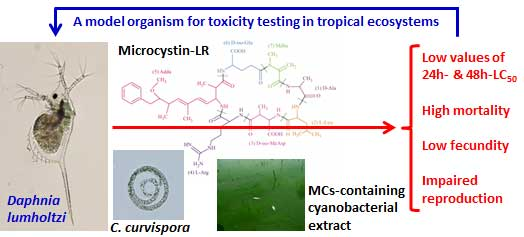
The mass development and expansion of cyanobacteria release cyanotoxins in the aquatic environment and cause serious problems for grazers such as micro-zooplankton. In contrast to aquatic ecosystems in temperate regions, impacts of cyanobacteria and their toxins on tropical micro-crustaceans are relatively understudied. In this study, acute and chronic effects of pure microcystin-LR (MC-LR), a crude extract of water bloom sample with a dominance of Microcystis aeruginosa containing microcystins (MCE) and living cells of Cylindrospermopsis curvispora were tested on a tropical micro-crustacean, Daphnia lumholtzi. The 24h– and 48h–LC50 values for MC-LR ranged from 247 – 299, and 331 – 409 µg MCE L-1, respectively. Exposures to 1 – 25 µg MCE L-1 decreased survival, fecundity, and reproduction of D. lumholtzi. The impacts of C. curvispora cells on life-history traits of D. lumholtzi were density-dependent and more severe than the impacts of dissolved microcystins. It could be that the adverse effects of C. curvispora on D. lumholtzi are linked to a combination of potential toxic metabolites, mal-nutrients, feeding and swimming interference. Daphnia lumholtzi used in this study is more sensitive to microcystins compared to Daphnia species from temperate regions. Therefore, we highly suggest using D. lumholtzi as a model species for toxicity testing and monitoring on water quality, particularly in tropical countries.
Keywords: acute lethal concentration, clutch size, Cylindrospermopsis curvispora, microcystins, reproduction, survival proportion