
Eco-friendly synthesis of durable aerogel composites from chitosan and pineapple leaf-based cellulose for Cr(VI) removal
Separation and Purification Technology 304 (2023) 122415
Authors: Luon Nguyen Tan a,b, Nhung Cam Thi Nguyen a,b, Anh Mai Hoang Trinh a,b, Nga H.N. Do a,b, Kien A. Le c, Phung K. Le a,b,*
a Refinery and Petrochemical Technology Research Centre, Ho Chi Minh City University of Technology (HCMUT), 268 Ly Thuong Kiet Street, District 10, Ho Chi Minh City, Viet Nam
b Vietnam National University Ho Chi Minh City, Linh Trung Ward, Thu Duc City, Ho Chi Minh City, Viet Nam
c Institute for Tropicalization and Environment, 57A Truong Quoc Dung Street, Phu Nhuan District, Ho Chi Minh City, Viet Nam
Accepted 14 October 2022
Available online 19 October 2022
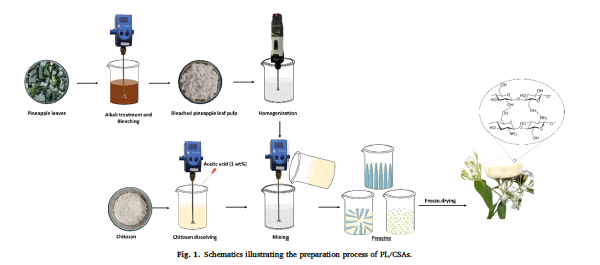
Abstract. Chromium (VI) oxyanion is one of the most toxic contaminants in water which causes cancer and genetic mutations in humans. In this work, the bio-based aerogels are successfully synthesized from pineapple leaves (PLs) and chitosan (CS) by an effective and eco-friendly method (including homogenizing, mixing, and freeze-drying) that is feasible for mass production to manage Cr(VI) pollution.
The influences of different freezing approaches (refrigerator, isotropic and anisotropic freezing), solid concentrations, and weight ratios of cellulose to chitosan on the morphology, physical parameters, and Cr(VI) adsorption of the aerogels are comprehensively investigated. The fabricated aerogels are ultra-lightweight (20–30 mg/cm3), highly porous (above 97.5%), durable (Young’s modulus of 1.8–11.7 kPa), and strongly acid resistant (below 12% of weight loss at pH 3).
The difference in pore size among freezing techniques is clarified by scanning electron microscopy, suggesting that anisotropic freezing is ineffective for non-nanoprecursors. The findings show the strong influence of chitosan content and pH of the medium on Cr(VI) adsorption of the PL/CS aerogels due to the electrostatic attraction between Cr(VI) oxyanions and protonated amine groups.
The theoretical Langmuir maximum Cr(VI) uptake is up to 210.6–211.4 mg/g, which is generally comparable to carbon-based and costly metal-organic framework materials.
The adsorption isotherm and kinetics of the samples are appropriate to the Langmuir model and the pseudo-second-order model, respectively. Furthermore, the Cr-absorption capacity retention rates of prepared aerogel are above 75% after 6 absorbing cycles by NaOH solution. Based on the results, the product cellulose/chitosan aerogel can be considered a potential adsorbent for Cr(VI) removal.