

Does eutrophication enhance greenhouse gas emissions in urbanized tropical estuaries?
Environmental Pollution 303 (2022) 119105
Authors: An Truong Nguyen a,b,* , Julien N´emery a,b , Nicolas Gratiot a,b , Thanh-Son Dao b,c , Tam Thi Minh Le b , Christine Baduel a,b , Josette Garnier d
a Univ. Grenoble Alpes, IRD, CNRS, Grenoble INP, IGE1 , F-38000, Grenoble, France
b CARE, Ho Chi Minh City University of Technology (HCMUT), VNU-HCM, 268 Ly Thuong Kiet Street, District 10, Ho Chi Minh City, Viet Nam
c Vietnam National University, Ho Chi Minh City, Viet Nam
d Sorbonne Universit´e, CNRS, EPHE, UMR 7619 Metis, BP 123, Tour 56-55, Etage 4, 4 Place Jussieu, 7500, Paris, France
Accepted 3 March 2022
Available online 8 March 2022
Abstract. Estuaries are considered as important sources of the global emission of greenhouse gases (GHGs). Urbanized estuaries often experience eutrophication under strong anthropogenic activities. Eutrophication can enhance phytoplankton abundance, leading to carbon dioxide (CO2) consumption in the water column. Only a few studies have evaluated the relationship between GHGs and eutrophication in estuaries. In this study, we assessed the concentrations and fluxes of CO2, methane (CH4) and nitrous oxide (N2O) in combination with a suite of biogeochemical variables in four sampling campaigns over two years in a highly urbanized tropical estuary in Southeast Asia (the Saigon River Estuary, Vietnam). The impact of eutrophication on GHGs was evaluated through several statistical methods and interpreted by biological processes. The average concentrations of CO2, CH4 and N2O at the Saigon River in 2019–2020 were 3174 ± 1725 μgC-CO2 L− 1 , 5.9 ± 16.8 μgC-CH4 L− 1 and 3.0 ± 4.8 μgN-N2O L− 1 , respectively. Their concentrations were 13–18 times, 52–332 times, and 9–37 times higher than the global mean concentrations of GHGs, respectively. While CO2 concentration had no clear seasonal pattern, N2O and CH4 concentrations significantly differed between the dry and the rainy seasons. The increase in eutrophication status along the dense urban area was linearly correlated with the increase in GHGs concentrations. The presence of both nitrification and denitrification resulted in elevated N2O concentrations in this urban area of the estuary. The high concentration of CO2 was contributed by the high concentration of organic carbon and mineralization process. GHGs fluxes at the Saigon River Estuary were comparable to other urbanized estuaries regardless of climatic condition. Control of eutrophication in urbanized estuaries through the implantation of efficient wastewater treatment facilities will be an effective solution in mitigating the global warming potential caused by estuarine emissions.
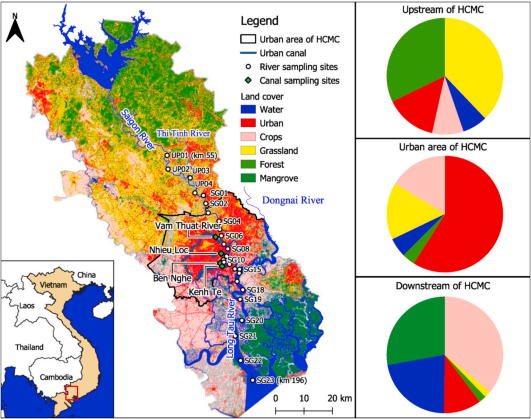
Fig. 1. Map of sampling sites and land cover along Saigon River Estuary. Point kilometers were based on distance from the outlet of reservoir to sampling sites (i.e., pK = 0 at Dau Tieng Reservoir, pK = 55 km at UP01, pK = 196 at SG23). Three sections (upstream: UP01 – SG03, urban area: SG04 – SG15 and downstream of HCMC: SG16 – SG23) along Saigon River were defined based on water quality conditions. The percentages of land cover were calculated based on the surface of each section. Land cover data were extracted from Phan et al., (2021). Grassland included abandoned agricultural land, grass, pastures, shrubs.