
Controlling factors of microplastic fibre settling through a water column
Science of the Total Environment 838 (2022) 156011
Authors: Thu Ha Nguyen a,b , Thuy-Chung Kieu-Le b,c,d,⁎ , Fiona H.M. Tang e, Federico Maggi f,g
a Faculty of Civil Engineering, Ho Chi Minh City University of Technology (HCMUT), Ho Chi Minh City, Viet Nam
b Vietnam National University Ho Chi Minh City (VNU-HCM), Ho Chi Minh City, Viet Nam
c Faculty of Geology and Petroleum Engineering, Ho Chi Minh City University of Technology (HCMUT), Ho Chi Minh City, Viet Nam
d Asian Center for Water Research (CARE), Ho Chi Minh City University of Technology (HCMUT), Ho Chi Minh City, Viet Nam
e School of Environmental and Rural Science, University of New England, Armidale, New South Wales 2350, Australia
f Environmental Engineering, School of Civil Engineering, The University of Sydney, Sydney, New South Wales, Australia
g Sydney Institute of Agriculture, Carbon, Soil and Water, The University of Sydney, Australia
Accepted 12 May 2022
Available online 17 May 2022
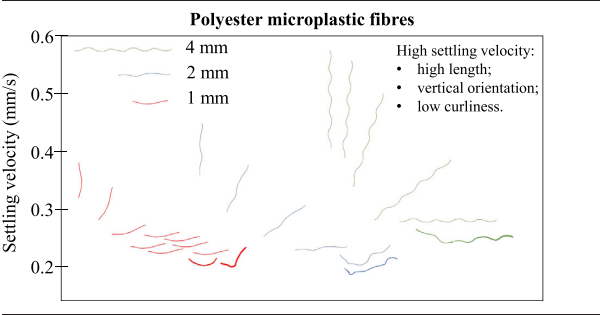
Abstract. Microplastic fibres are the most abundant microplastics in waterways worldwide. The settling of fibres is distinct from other particles because of their aspect ratio and shape. In this paper, we test the hypothesis that length, curliness, and settling orientation control the settling velocity of microplastic fibres in a suite of laboratory experiments.
Using a Particle Tracking Velocimetry method, we measured the settling velocity of 683 polyester microplastic fibres of 1 to 4 mm in length. Experimental findings support our hypothesis that for microplastic fibre longer than 1 mm, changing settling orientation from horizontal to vertical can increase 1.7 times the settling velocity. Fibre curliness can significantly reduce the settling velocity, where a curly fibre 1.3 times longer than a straight fibre can settle 1.75 times slower. In contrast, short microplastic fibres (less than 1 mm) mostly settle horizontally, and their settling velocity is unaffected by curliness.
The drag force exerting on settling microplastic fibres was analysed, and the sphere-equivalent diameter was found to be a good representation of microplastic fibre size to predict the drag coefficient. Measured settling velocity ranges between 0.1 and 0.55 mm/s and exhibits a slight increase with the increasing length of the fibres. This lowvelocity range raises concerns that microplastic fibres can favour biological flocculation, form clustered aggregates with microorganisms, feed aquatic organisms and cause bioaccumulation at higher trophic levels.